


















A plane ticket gets pricier the closer you get to takeoff, and a rideshare fare jumps when it rains. Those prices respond to demand as it happens. Shipping works a little differently. Carriers rarely reprice by the minute, but they do often adjust what you pay, and implement rates through more mechanisms than a single January increase.
The catch is that each type of change looks different on your statement and calls for a different fix. Knowing which one you’re dealing with is the first step toward protecting your margins.
During busy stretches, USPS generally raises the price of postage itself rather than adding a separate fee. Over the course of a year, that can mean limited-time increases, a temporary peak-season price, and changes to the formulas that determine what a package costs to send. The price on a label in October may not be the same as the price on an identical label in January, so budgeting around one annual adjustment no longer holds up.
USPS is upfront about its approach. It labels its holiday increase a temporary price change, not a surcharge. When it announced an 8% time-limited increase in March of 2026, it pointed out that other carriers had chosen surcharges to cover higher costs while USPS had not. According to USPS, recent temporary increases help cover transportation and the extra handling required during the holidays.
Because there’s no separate line item, these increases are easy to overlook. USPS publishes its price list, and your Stamps.com rates reflect the discount tied to your account. Unless you’re comparing the cost of an identical shipment from one month to the next, the change may show up only as a higher monthly total.
UPS and FedEx take a different approach. Each publishes named demand surcharges that are charged per package, on top of all other applicable fees.
For this season:
UPS: Demand surcharges on Additional Handling, Large Package, and Over Maximum packages started September 27. Charges on UPS Ground residential deliveries and eligible air services start October 25 and continue through January 16, 2027. Details are available on UPS’s Demand Surcharges page.
FedEx: Additional Handling and Oversize surcharges took effect September 28. Residential and express charges start October 26 and continue through January 17, 2027. Details are available on FedEx’s Demand Surcharges page.
FedEx’s Demand – Residential Delivery Charge is the closest thing to genuine dynamic pricing in the group. It can change week to week based on a shipper’s volume and peaking factor, responding to what’s actually happening rather than following a preset seasonal rate.
Both carriers reserve the right to change these windows, so treat the end dates as a forecast, not a guarantee.
Peak-season pricing gets the headlines. This change didn’t.
As of July 12, USPS revised how it calculates dimensional (DIM) weight, the billable weight based on a box’s size rather than what it actually weighs. For eligible competitive package products larger than one cubic foot, USPS now divides by 139 and rounds each dimension up to the next full inch.
A quick example: A 5-lb coffee maker ships in a 12.25″ × 12.25″ × 12.25″ box. After rounding, the box measures 13″ × 13″ × 13″, or 2,197 cubic inches. Divide that by 139, and you’re billed for 16 lbs, more than three times the actual weight.
Packaging is one of the biggest levers you control. Take your 20 best-selling USPS SKUs, apply the new calculation to each, and switch to smaller boxes wherever the savings make sense.
Measure the packed box, not the product inside it. A box that’s even slightly past a whole-inch mark gets rounded up to the next inch. Start with lightweight items shipping in roomy boxes, since the box size, not the product, determines their billable weight.
As prices shift, so does the cheapest option for any given package. Checking rates manually means you’re always working with yesterday’s numbers.
Looking up a single rate isn’t enough, either. Effective rate shopping compares services across every carrier you use, order by order, and selects the best match for your rules. When prices change, the comparison reflects those changes right away.
If nearly everything ships with one carrier, any change to its pricing affects your entire shipping budget. Spreading volume across carriers gives you more opportunities to find a good rate and a fallback if service slips. It also gives you more leverage when negotiating.
Compare carriers based on the weights and zones you actually ship. A light parcel might be cheapest with one carrier, while a heavy cross-country box might be cheaper with another. The winner can change with the season.
With UPS and FedEx, track each demand surcharge as its own line item instead of watching only the total. With USPS, where increases are built into the postage, choose a few shipments you send regularly and compare their label costs month over month.
Dynamic shipping rates take different forms. UPS and FedEx identify their changes as surcharges, while USPS builds its changes into the price itself. Either way, the playbook is the same: right-size your packaging, compare rates on every order, spread your volume across carriers, and track your own costs.
Carrier pricing will keep moving. What matters is whether you catch the changes. Get started with Stamps.com and compare your shipping options on every order, so the next price change doesn’t catch you by surprise.
Yes. Our reports show you you activity and total spend by carrier, mail class, shipping service -- so you always know how much you send. You can customize your reports by date and, if you are on our multi-location plan, you can also view activity and spend per location and user.
No. Our negotiated carrier discounts ensure you pay less for First Class Mail® stamps and get up 88% off shipping services from USPS, UPS, and other top carriers. These are discounts you will not find at the Post Office as they are reserved for high volume enterprises. Check stamps.com/carriers for latest on carriers and rates.
Our rate advisor feature helps you calculate exact postage or shipping rate for anything you send. All you need is your item's weight and dimensions -- we do all the math for you and recommend cheapest, fastest, and best rates across all carriers.
Delivery is made by the country's postal service in 3 - 5 business days, depending on the destination.
Generally, it takes Priority Mail International six to ten business days. USPS hands off shipments at the border of the destination country before the local postal service completes the delivery.
While price varies depending on weight and destination, rates for this service begin at $17 dollars.
USPS Priority Mail generally delivers in 2-3 business days. First-Class Mail, while more economical, typically takes 1-5 business days for delivery.
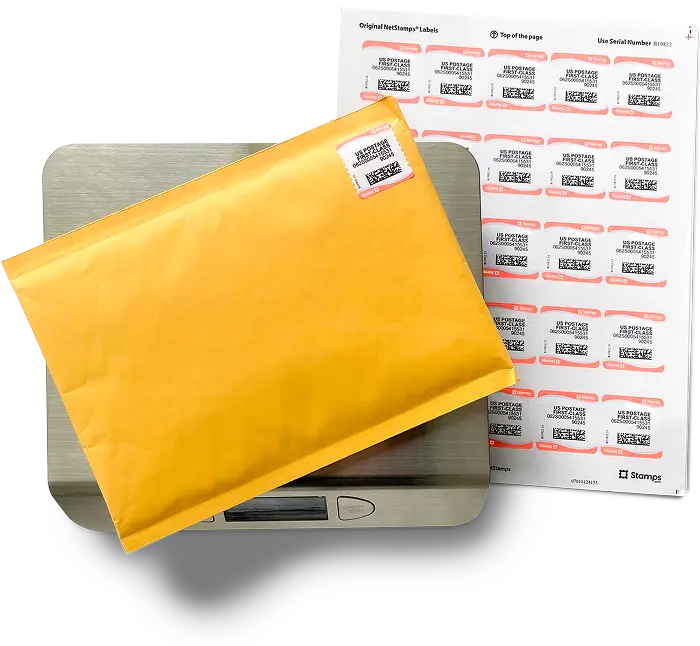
NetStamps are USPS-approved blank labels on which you can print your own stamps. Simply buy postage on Stamps.com, use any printer to print on a NetStamps sheet or roll, and stick the NetStamp to an envelope, postcard, or other First Class Mail.
Nonmachinable envelopes might be non-rectangular, rigid, unevenly thick, or have non-paper closures, meaning they cannot be processed efficiently by USPS's automated sorting equipment, and require special handling, resulting in a surcharge in addition to the standard postage.
Regular, Legal, and Padded
Packages up to 15.999 ounces are priced in 4-ounce increments, while heavier packages are charged by the pound, rounded up. The further the distance, the higher the cost. Additional fees apply to oversized packages. Easily calculate discounted rates anytime at Stamps.com.
USPS Priority Mail typically takes one to three business days, depending on destination, to deliver. You can easily check for a delivery time estimate on USPS’s Priority Mail Delivery Map.
Educational materials like books, music, or videos that never include any products or advertising.
With USPS, Stamps.com customers have access to Commercial Base, Commercial Plus, Cubic Pricing, and Negotiated Service Agreements. Savings include:
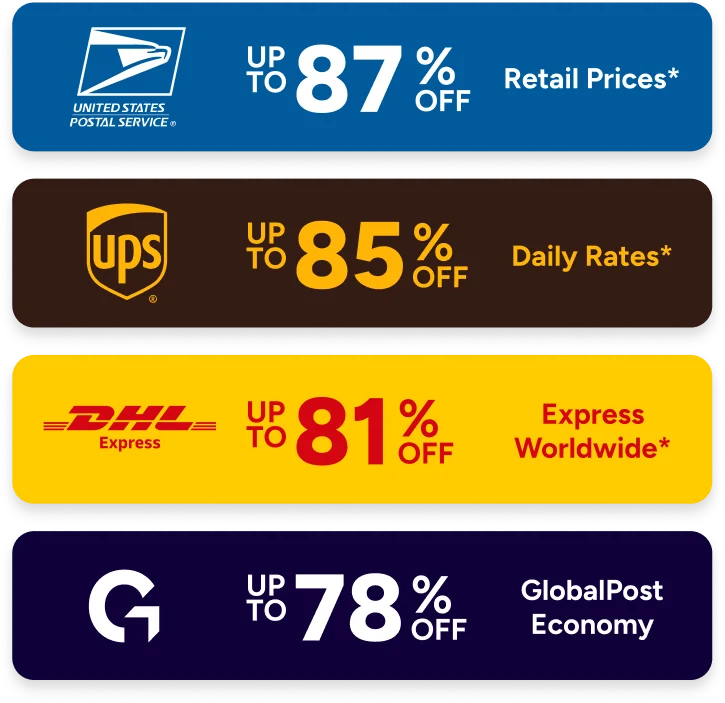
With UPS, Stamps.com customers get up to 73% off UPS 2nd Day Air® and up to 77% off UPS® Ground Daily Rates.* Plus, many common surcharges are waived, including the residential surcharge for UPS Ground shipments.
*UPS rates are limited to shipping from the continental U.S. only. These rates and discounts exclude shipment origins from Hawaii, Puerto Rico, and Alaska. These rates and any applicable discounts are subject to change at any time without notice.
First-Class Mail International®
Flat Rate Envelopes are ideal for documents or small, dense items weighing 4 lbs or less, as they offer a single price based on the destination country. For items between 4 lbs and 70 lbs, or those that don't fit into the Flat Rate Envelopes, you'll need to ship by weight using your own packaging. It’s more affordable to use Flat Rate boxes if your item is under 20 lbs.