





















Opening a second office felt like a milestone. The third felt like momentum. By the time you hit five or more, the growth story was writing itself—more clients, more revenue, more reach.
But somewhere along the way, something shifted. The processes that worked in a single office started showing cracks. Different locations developed their own way of doing things—different software, different vendors, different workflows. Nobody made a bad decision. Everyone just made their own decisions.
That’s how multi-location management breaks down. Not in one dramatic failure, but in dozens of small, reasonable choices that compound into a structural gap between how fast you’re growing and how well your operations can keep up.
According to JPMorganChase’s 2026 Business Leaders Outlook survey, roughly 73% of midsize business leaders expect to increase revenue this year, and nearly half plan to expand their teams. That’s more locations, more employees, and more operational complexity flowing through more offices. The firms that tighten up their multi-location business operations now will scale more smoothly. The ones that don’t will keep compounding the same invisible costs.
Here are six things that tend to break first—and how to fix each one.
When a single office picks its own tools, it feels like autonomy. When 15 offices each pick their own tools, it’s chaos.
The average company now uses 112 SaaS applications, and organizations with over 5,000 employees average 158. But the real problem isn’t the number—it’s the disconnect. Research from MuleSoft found that organizations average 897 applications, but only 29% are integrated. Every disconnected system becomes its own island of information, preventing unified reporting and automation.
For businesses with multiple locations, this plays out in predictable ways. One office uses QuickBooks, another uses Xero. One location tracks projects in Monday.com, another uses shared spreadsheets. The CRM is supposed to be company-wide, but three locations never fully adopted it. IT can’t support what it can’t see, and leadership can’t make decisions based on data that doesn’t connect.
How to fix it: You don’t need to mandate one tool for everything—but you do need a core stack that every location runs on, with clear policies for exceptions and a centralized view of what’s actually in use. Start by auditing what each office runs. You may be surprised how much overlap (and redundancy) already exists. Not sure where your operations stand? This quick efficiency assessment can help you spot the gaps.
Every vendor relationship comes with administrative overhead: a contract to manage, an invoice to process, a renewal to track, a relationship to maintain. When each location independently chooses its own vendors for the same functions, that overhead multiplies without adding any value.
This is one of the hardest parts of multi-location accounting for service businesses. Costs get scattered across dozens of invoices, credit card statements, and petty cash receipts. Procurement can’t negotiate better rates because the team doesn’t know the organization’s total volume across locations. Finance can’t allocate costs accurately because there’s no centralized reporting.
The pattern shows up everywhere—office supplies, printing services, IT support, mailing, and shipping. Some organizations discover they have duplicate accounts with the same vendor across different locations, each with different pricing. Others find they’re paying late fees on contracts nobody is actively monitoring.
How to fix it: Consolidate where you can, standardize where it matters, and build a single view of total spend. Every duplicate vendor relationship is overhead without advantage. A single platform for a given function means one contract, one set of reports, and real negotiating leverage. For multi-location businesses evaluating procurement solutions, mailing and shipping is often the easiest place to consolidate first because it touches every office, and the savings are immediate.
Ask a single-location business how much they spend on supplies, software, or shipping, and they can usually tell you. Ask a 20-location business the same question and you’ll get silence—or a number that takes three weeks and a finance analyst to produce.
That’s the visibility problem. When every location operates independently, the data that leadership needs to make informed decisions simply doesn’t exist in one place. You can’t optimize what you can’t see, and you can’t benchmark what you can’t compare.
This goes beyond financial reporting. It extends to operational questions like which locations are most efficient, where bottlenecks form, and how new offices compare to established ones during their first 90 days. Without centralized visibility, every location is an island—and the organization loses the ability to learn from its own performance.
How to fix it: Centralize visibility, not control. The goal isn’t to micromanage every office—it’s centralized reporting (spend by location, by user, by cost code), centralized rate management (so every location gets the same discounted rates), and role-based permissions (so the right people see the right data without slowing anyone down). Let locations handle day-to-day decisions, but give leadership the dashboard they need to spot problems early and allocate resources intelligently.
Opening a new office should take weeks, not months. But for businesses with multiple locations and no standardized playbook, every new site means reinventing the wheel—setting up accounts, choosing vendors, configuring software, training staff, and figuring out processes that other locations solved years ago.
This is especially common among small businesses operating in multiple states, where regulatory requirements, tax structures, and compliance obligations vary. Without a documented, repeatable process, each new location inherits whatever its local team decides to set up—and the gap between locations widens every time.
How to fix it: Treat location onboarding like a product launch: a checklist, a timeline, a standard stack, and a clear owner. Document the standard vendors, the standard setup process, and the standard training materials. Every new location should be operational in days, not months. The firms that scale smoothly have playbooks. The ones that don’t end up with 20 locations that each operate like independent businesses sharing a name.
This one hits close to home for anyone who’s watched a $45-an-hour paralegal spend their morning standing in line to mail certified letters. Or an office manager at an accounting firm hand-calculating postage during tax season. Or an HR coordinator manually entering the same employee data into four different systems because none of them talk to each other.
Research suggests that employees spend roughly 60% of their time on “work about work”—coordination, status updates, searching for information, and duplicating effort across disconnected tools—rather than the skilled work they were hired to do. In a multi-location environment, this problem multiplies. When locations don’t share processes or systems, every office reinvents the same workarounds independently.
The time adds up fast. Even 30 minutes per day of avoidable manual work, per location, across 20 offices comes out to over 2,500 hours a year—hours that could be spent on client work, business development, or operational improvement.
How to fix it: Replace hardware with software and manual processes with automated ones. Physical infrastructure that made sense for single-location businesses—postage meters, on-premise servers, manual filing systems—doesn’t scale. Cloud platforms let any employee access tools from any location without leased hardware or long-term contracts. For a closer look at where mailing-specific time waste hides, here are five practical ways to streamline office mail that apply whether you have one office or fifty.
Of all the operational functions that break down across multiple locations, mailing and shipping might be the least glamorous—but it’s also the most universal and one of the fastest to fix.
Every location mails something. Every location ships something. And in most multi-location businesses, every location handles it differently. One office prints postage online. Another drives to the post office. A third uses a legacy postage meter with a lease that auto-renewed two years ago. There’s no standard, so there’s no way to compare performance, cost, or efficiency between sites.
The numbers behind this are striking. A Stamps.com survey of business professionals found that 78% make frequent trips to mailing locations, and 68% regularly interrupt important work to handle mailing tasks. The average post office trip takes about 20 minutes once you factor in travel, parking, and waiting. A business owner making two to three trips per week spends roughly 50 hours per year on mailing logistics alone—about $2,500 in lost productivity. Now multiply that across 10, 20, or 80 locations.
Postage meters make it worse. The hardware leases are long-term, auto-renewing, and often come with finance charges and insurance fees that weren’t clearly explained upfront. Some organizations discover they have duplicate meter accounts across locations, each with different pricing, and they’re paying late fees on accounts nobody is actively monitoring.
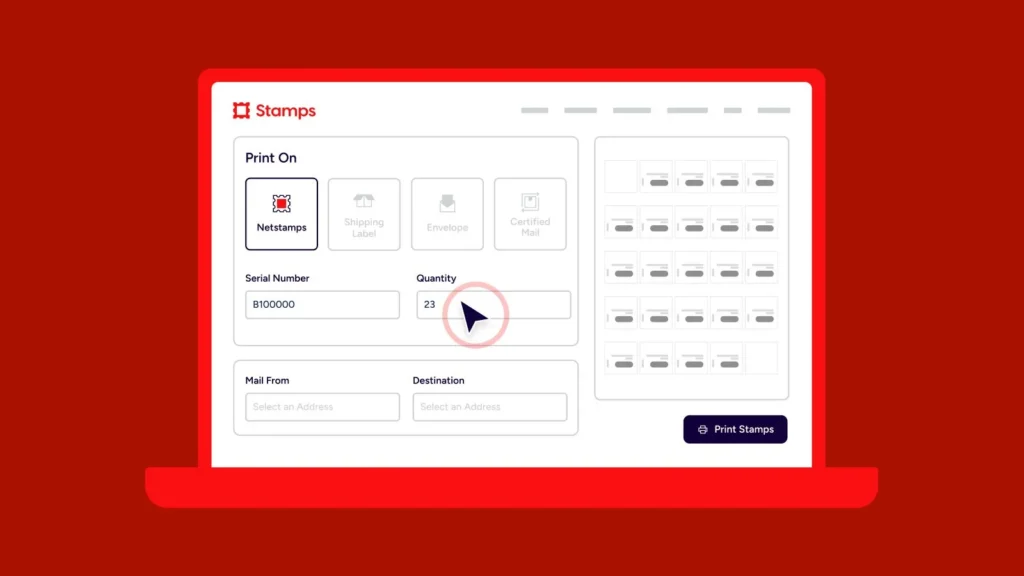
How to fix it: This is the quick win. Consolidate mailing and shipping onto a single cloud-based platform across all locations. No hardware, no leases, no contracts. Every employee prints postage and labels from their desk. Every location gets the same discounted rates. And leadership gets a single dashboard showing total spend, volume, and activity across the entire organization.
Midwest Vision, an optometry practice with 80 locations across the Midwest, is a good example. Before consolidating, the practice had duplicate accounts with legacy postage meter providers across multiple offices, each with different pricing. Late fees were piling up on accounts nobody was actively managing, and finance charges from one vendor were never clearly communicated upfront.
I’m focused on account consolidation, making sure all locations get the same price and fostering strong partnerships with our vendors.
Adriana Hurtado, Procurement Manager, Midwest Vision
After switching to a centralized mailing platform, Midwest Vision consolidated all 80 locations under a single account with uniform pricing, eliminated hardware leases, and gained full visibility into mailing activity across the entire organization. The result was more than $300,000 in savings.
With Stamps.com, it’s a lot less hunting down. Adding funds and locations has been seamless.
Adriana Hurtado, Procurement Manager, Midwest Vision
That’s not really a technology story. It’s an operations story. The platform was the mechanism, but the real win was consolidation, visibility, and control—the same principles that apply to every function on this list.
If you’re running a multi-location business and any of the following sound familiar, the gaps are probably bigger than they look:
None of these are crises on their own. But together, they paint a picture of an operation that’s grown faster than its systems—and the longer they go unaddressed, the more they cost.
Multi-location growth is a sign that you’re doing something right. But growth without operational alignment means you’re scaling your inefficiencies right along with your revenue.
The businesses that get this right don’t necessarily spend more on operations. They spend smarter. They consolidate where it makes sense, centralize visibility without centralizing control, and choose tools that scale without adding overhead.
And they start somewhere. For many multi-location businesses, mailing and shipping is the fastest operational upgrade—not because it’s the most complex, but because it’s the one that touches every office and delivers results before the next quarterly review.
Ready to simplify mailing and shipping across your locations? See how Stamps.com’s multi-location solution gives you centralized control, discounted rates, and reporting across every office.