

















Postage is one of those line items that tends to quietly balloon. A few cents here, a rate adjustment there—and suddenly your annual mailing budget looks nothing like it did two years ago. For businesses that rely on physical mail to send invoices, contracts, client communications, and packages, the rising cost of postage isn’t just an inconvenience. It’s a margin issue.
Since 2020, the price of a First-Class Mail Forever stamp has risen 42%, climbing from $0.55 to $0.78. USPS shipping services were updated in January 2026 as part of the agency’s ongoing Delivering for America modernization plan, with Ground Advantage rates adjusting by 7.8% and Priority Mail by 6.6%. These changes reflect broader market conditions—fuel costs, infrastructure investments, and the operational realities of maintaining a nationwide delivery network. And with additional adjustments expected through at least 2027, postage is a cost that businesses need to plan around proactively.
The good news? There are more tools and strategies available today than ever before to help you manage that spend. Here’s how to save money on business postage in 2026—and actually keep those savings over time.

One of the fastest ways to save money on business postage is to stop relying on guesswork. Manual postage calculations—estimating weights, eyeballing package dimensions, defaulting to the same carrier and service every time—almost always result in overspending.
Rate comparison tools take the math out of the equation. Instead of defaulting to the same service for every piece of mail, rate comparison lets you see what each carrier and service class will actually cost for a given mailpiece based on its weight, dimensions, and destination. Sometimes a different service gets your mail there just as fast for significantly less. You just never knew because you never compared.
Stamps.com’s Rate Advisor does exactly this: it automatically calculates and compares rates across UPS, USPS, and other carriers so you can choose the most cost-effective option every time. The platform also calculates postage down to the exact ounce, which means you’re never paying for weight you don’t have.
For businesses sending even moderate volumes of mail, that precision adds up to real savings—without adding any extra work to the process.
Most businesses don’t realize that the price they pay at a retail counter or through standard online tools isn’t the only rate available to them. Carriers like USPS offer commercial pricing tiers that are significantly lower than retail rates, but those discounts are typically reserved for high-volume shippers or businesses using approved postage platforms.
With Stamps.com, businesses of all sizes can access pre-negotiated commercial rates without needing to meet high-volume thresholds. That means discounts on First-Class Mail, Priority Mail, Ground Advantage, and more—savings that are applied automatically every time you print a label.
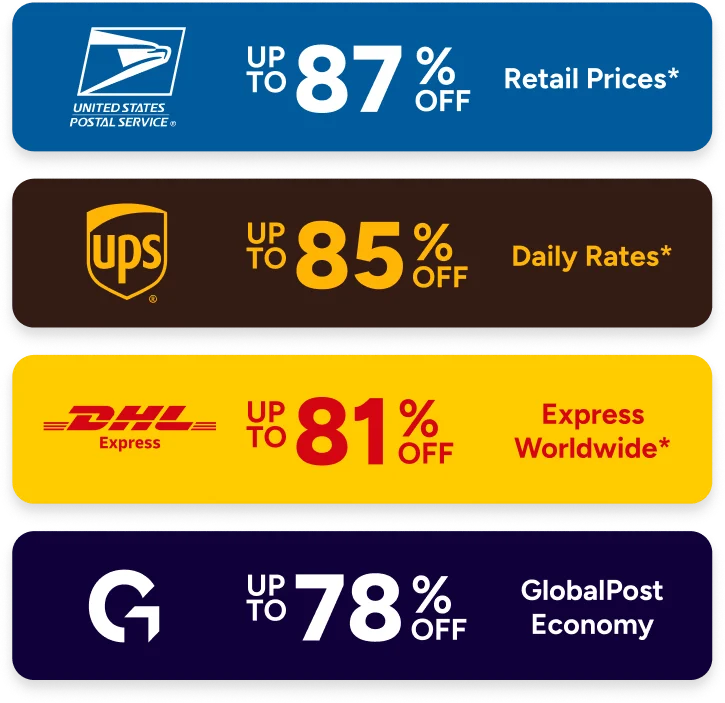
To put it in perspective: Stamps.com users can access significant savings across services:
If you’re still buying stamps at retail or paying counter rates for shipping labels, switching to a platform with built-in commercial pricing is one of the single highest-impact changes you can make to save money on business postage.
The math on postage savings becomes a lot more tangible when you see it playing out in a real business. Gary Siano, owner of Bearcat Billing Service, a medical billing company in Ohio, processes 200 to 400 mailers multiple times per week on behalf of his 80+ clients. At that volume—over $2,000 per month in postage—every cent per piece matters.
When Siano switched to Stamps.com, the savings were immediate. Discounted per-piece rates, combined with the ability to print postage on his own schedule without leaving the office, eliminated both the direct and indirect costs that had been quietly eating into his margins. “The most reliable and affordable way to satisfy your mailing needs,” is how Siano described the platform’s impact on his business.
What started as a cost-saving decision also became a growth enabler. As Bearcat Billing scaled—adding clients and increasing mail volume year over year—the platform scaled with it. No new equipment, no new processes, no new headaches.
Stamps.com is the most reliable and affordable way to satisfy your mailing needs.
—Gary Siano, Owner, Bearcat Billing Service

When people think about mailing expenses, they tend to focus on the price printed on the stamp or label. But the real cost of business postage goes well beyond the rate you pay per piece.
Consider the time it takes to prepare, calculate, and send mail. In a recent survey of 200 working professionals, we found that more than half of respondents spend two or more hours per week on mailing and shipping tasks alone. Nearly one in eight reported making a mailing trip every single day. That’s time pulled directly away from revenue-generating work—time spent on logistics instead of serving clients or growing the business.
And then there’s the waste that comes from uncertainty. That same survey revealed that nearly 60% of respondents said they are sometimes or often unsure about the correct postage amount when they mail. The uncertainty adds up: overpaying by even a few cents per piece across hundreds or thousands of mailings per year creates a significant and completely avoidable expense.
The first step toward cutting your postage costs is recognizing that postage isn’t just a price-per-piece problem—it’s an operational one.
For years, postage meters were the go-to solution for businesses that mailed frequently. But in 2026, they’re an increasingly expensive and inflexible option. Meter leases, maintenance fees, ink cartridges, and periodic rate update charges all add to total cost of ownership—often without the user fully realizing how much they’re spending.
There’s also a compliance factor. USPS now requires all postage devices to use Intelligent Mail Indicia (IMI) technology. Businesses still running older, non-compliant meters face the cost of upgrading or replacing their equipment entirely.
Cloud-based postage platforms like Stamps.com eliminate all of that overhead. There’s no hardware lease, no ink to replace, and no rate update fees. Rates update automatically when carriers make changes, and you can print postage from any computer or mobile device. It’s a simpler model that also happens to be a cheaper one.

Carrier diversification is smart, but carrier chaos is costly. Many businesses end up managing separate accounts, logins, and billing relationships across multiple carriers—each with their own rate structures, surcharges, and billing cycles. The result is a lack of visibility into total postage spend and missed opportunities to optimize.
Consolidating your carrier management into a single platform gives you a unified view of what you’re spending and where. When you can compare rates side-by-side and route mail to the most cost-effective option in real time, you make better decisions on every piece you send. That visibility also makes it easier to spot trends: maybe your package volume has shifted in a way that makes a different service class more economical, or maybe a carrier surcharge is quietly inflating your costs.
Stamps.com gives you access to UPS, USPS, and other major carriers through one interface, so you can compare, choose, and print—all without toggling between systems.
It’s nearly impossible to save money on business postage if you don’t know where you’re spending it. Most businesses have a general sense of their monthly postage budget, but few have the granular data needed to identify inefficiencies.
Good reporting tools let you break down spend by carrier, mail class, service type, location, and even individual users. That kind of detail surfaces patterns you wouldn’t catch otherwise: a team that consistently overpays by using Priority Mail when Ground Advantage would suffice, a location that’s spending significantly more per piece than others, or a seasonal spike that could be managed with better planning.
Stamps.com’s built-in reporting and analytics give you that visibility. For multi-location organizations especially, the ability to see spending at the corporate, regional, and individual level makes it far easier to allocate budgets, enforce policies, and track savings over time.
Sometimes the best way to reduce postage costs isn’t about rates at all—it’s about eliminating unnecessary steps and inefficiencies in how mail gets out the door.
Think about your current process. Who handles mailing? Where do they do it? How much of their time goes into preparing, calculating, and physically transporting mail? Our survey found that 68% of professionals interrupt important work at least once per week to handle mailing tasks. That’s time away from the work that actually moves the business forward.
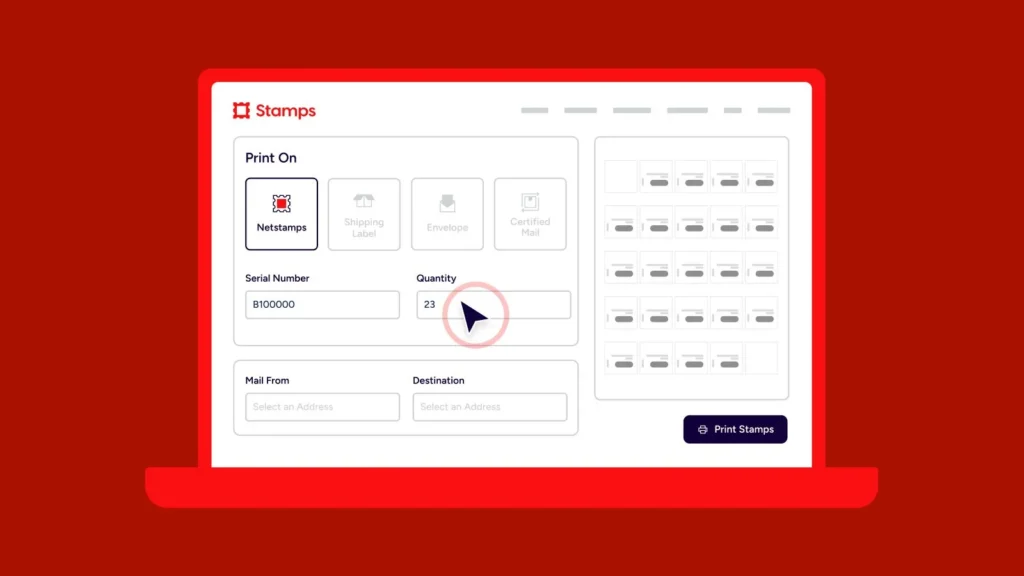
Shifting to a workflow where postage is printed on-demand from a desk or office eliminates the travel, the wait times, and the work interruptions. Scheduling carrier pickups instead of making drop-off trips saves even more time. And batch-printing labels for high-volume sends compresses what might take hours into a matter of minutes.
These workflow improvements don’t just save time. They save money by reducing the hidden labor costs wrapped into every piece of mail your business sends.

USPS has been transparent about its pricing trajectory, which is helpful for businesses that want to plan ahead. Under the Delivering for America plan, the agency is making significant investments in infrastructure and service reliability, and rate adjustments are part of how it funds those improvements. Mailing services saw a 7.4% adjustment in July 2025. Shipping services followed with updates ranging from 5.1% to 7.8% in January 2026.
Businesses that plan for these adjustments—rather than reacting to them—are in a much stronger position to control costs. That means building rate changes into your annual budget, taking advantage of commercial rates where possible, and using tools that automatically update when prices change so you’re never caught off-guard.
It also means being strategic about when and how you mail. Timing high-volume sends to avoid peak-season surcharges, right-sizing packaging to minimize dimensional weight charges, and verifying addresses to prevent costly returns are all small moves that add up significantly over the course of a year.
You don’t need to overhaul your entire mailing operation overnight. For most businesses, the highest-impact first step is simply moving from retail postage to a platform that gives you access to commercial rates and automated rate comparison.
From there, add reporting visibility so you can track what’s working. Consolidate your carriers into one dashboard. Schedule pickups. Start batch-printing. Each improvement builds on the last, and the cumulative effect on your postage spend can be substantial.
Postage rates will continue to evolve as carriers invest in their networks and services. But with the right tools and a proactive approach, you can absolutely save money on business postage—and put those savings back into what your business does best.
Ready to start saving? Try Stamps.com free for 30 days and see how much your business could save on postage and shipping.
Yes. Our reports show you you activity and total spend by carrier, mail class, shipping service -- so you always know how much you send. You can customize your reports by date and, if you are on our multi-location plan, you can also view activity and spend per location and user.
No. Our negotiated carrier discounts ensure you pay less for First Class Mail® stamps and get up 88% off shipping services from USPS, UPS, and other top carriers. These are discounts you will not find at the Post Office as they are reserved for high volume enterprises. Check stamps.com/carriers for latest on carriers and rates.
Our rate advisor feature helps you calculate exact postage or shipping rate for anything you send. All you need is your item's weight and dimensions -- we do all the math for you and recommend cheapest, fastest, and best rates across all carriers.
Delivery is made by the country's postal service in 3 - 5 business days, depending on the destination.
Generally, it takes Priority Mail International six to ten business days. USPS hands off shipments at the border of the destination country before the local postal service completes the delivery.
While price varies depending on weight and destination, rates for this service begin at $17 dollars.
USPS Priority Mail generally delivers in 2-3 business days. First-Class Mail, while more economical, typically takes 1-5 business days for delivery.
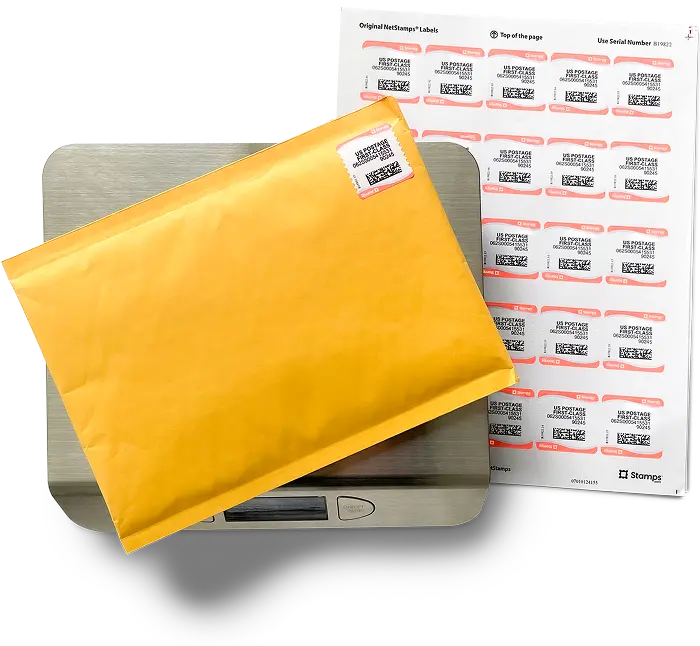
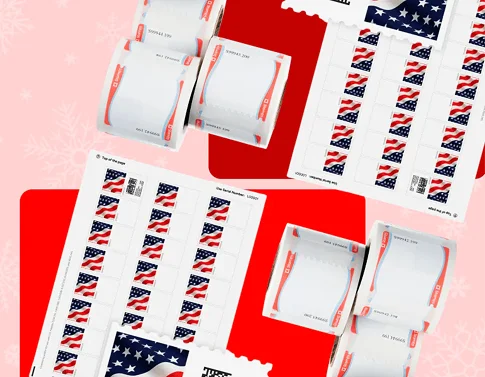
NetStamps are USPS-approved blank labels on which you can print your own stamps. Simply buy postage on Stamps.com, use any printer to print on a NetStamps sheet or roll, and stick the NetStamp to an envelope, postcard, or other First Class Mail.
Nonmachinable envelopes might be non-rectangular, rigid, unevenly thick, or have non-paper closures, meaning they cannot be processed efficiently by USPS's automated sorting equipment, and require special handling, resulting in a surcharge in addition to the standard postage.
Regular, Legal, and Padded
Packages up to 15.999 ounces are priced in 4-ounce increments, while heavier packages are charged by the pound, rounded up. The further the distance, the higher the cost. Additional fees apply to oversized packages. Easily calculate discounted rates anytime at Stamps.com.
USPS Priority Mail typically takes one to three business days, depending on destination, to deliver. You can easily check for a delivery time estimate on USPS’s Priority Mail Delivery Map.
Educational materials like books, music, or videos that never include any products or advertising.
With USPS, Stamps.com customers have access to Commercial Base, Commercial Plus, Cubic Pricing, and Negotiated Service Agreements. Savings include:
With UPS, Stamps.com customers get up to 73% off UPS 2nd Day Air® and up to 77% off UPS® Ground Daily Rates.* Plus, many common surcharges are waived, including the residential surcharge for UPS Ground shipments.
*UPS rates are limited to shipping from the continental U.S. only. These rates and discounts exclude shipment origins from Hawaii, Puerto Rico, and Alaska. These rates and any applicable discounts are subject to change at any time without notice.
First-Class Mail International®
Flat Rate Envelopes are ideal for documents or small, dense items weighing 4 lbs or less, as they offer a single price based on the destination country. For items between 4 lbs and 70 lbs, or those that don't fit into the Flat Rate Envelopes, you'll need to ship by weight using your own packaging. It’s more affordable to use Flat Rate boxes if your item is under 20 lbs.