
















Fresh flowers don’t seem like obvious candidates for the mail. They’re perishable. They’re fragile. And between transit time and box handling, a lot can go wrong. But people ship fresh flowers every day—and when it’s done right, a real bouquet arrives looking like it just left the florist. Here’s what “done right” actually looks like.
With Mother’s Day on May 10, there’s still time to pull this off. But not a lot of it—which is exactly why it helps to know the steps before you start packing.
The first decision happens before you pack anything. Some flowers are built for a day or two in a box. Others aren’t.
Hardy varieties that travel well: roses (ship them in bud form—they’ll open beautifully on arrival), carnations, sunflowers, chrysanthemums, alstroemeria (Peruvian lily), and statice or other fillers. These hold up through transit without bruising or wilting quickly.
Skip anything delicate: orchids, gardenias, sweet peas, or anything with fragile petals that crush at a touch. If you’re working with a local florist, ask which stems they’d recommend for a mailed arrangement.
Flowers need one thing in transit: moisture at the stems. Not moisture everywhere—just at the cut ends. Everything else is about protecting the blooms from damage.
Here’s the method:
Then spend 30 seconds on the outside of the box. Write “Contains Flowers,” “Perishable,” and “This Side Up” clearly on at least two sides. Carriers handle labeled packages more carefully. It’s worth doing.
Include a note inside asking the recipient to open the box as soon as it arrives and get the stems in water. Don’t assume they’ll know the timing matters.
This is the most important decision. You’re shipping something perishable—you need a 1–2 day delivery window, not a 3–5 day one.
USPS Priority Mail Express is a great choice for domestic fresh flower shipments. It delivers in 1–2 days and, critically, delivers on Sundays and holidays.
UPS and FedEx also offer overnight options if you’re cutting it very close and need a guaranteed next-day window. But for most domestic shipments, Priority Mail Express delivers on time at a lower cost—and it reaches virtually every U.S. address.
Don’t ship fresh flowers via standard Priority Mail (the 2–3 day service). That extra day in the box is the difference between a beautiful bouquet and a wilted disappointment.
Here’s a simple rule: don’t ship fresh flowers more than 48 hours before you want them to arrive.
For a Mother’s Day delivery on Sunday, May 10:
If you’re purchasing from a florist who handles their own shipping, they’ll often use insulated packing and know the timing. If you’re arranging and packing yourself, stick to this window.
Here’s what most people don’t think about: you can print a Priority Mail Express label from your home printer and never stand in line.
With Stamps.com, you enter your package details, select Priority Mail Express, and print a prepaid label in a few minutes. You also get access to pre-negotiated USPS rates—lower than retail counter pricing.
From there, schedule a USPS pickup or drop the box at any collection point. That’s the full process. For a time-sensitive shipment like fresh flowers, removing every unnecessary step matters.
Priority Mail Express includes some base coverage. If you’re sending a premium arrangement—anything in the $50–$100+ range—it’s worth adding extra insurance when you create the label. It costs a few dollars and protects against the rare case where something goes wrong in transit.
You can add it directly in Stamps.com when you set up the shipment.
Don’t refrigerate the packed box before shipping. Cold plus condensation can damage blooms before they’re even picked up.
Don’t seal the box completely airtight. A few small pinholes in the sides allow minimal airflow, which helps the flowers stay fresh longer.
Don’t wait until Friday afternoon if you need a Saturday pickup scheduled. Confirm your USPS pickup cutoff times—particularly around holidays—and allow extra margin.
A real bouquet is different from a digital gift card or a shipped floral substitute. When the person you’re sending to is far away, flowers that actually arrive fresh carry a meaning that a same-day delivery service can’t quite replicate—because you took the time to send something that needed care.
The process isn’t complicated once you know it. The right flowers, stems kept hydrated, a sturdy box, Priority Mail Express, and a label printed in minutes at home. That’s it.
Start mailing smarter with Stamps.com.
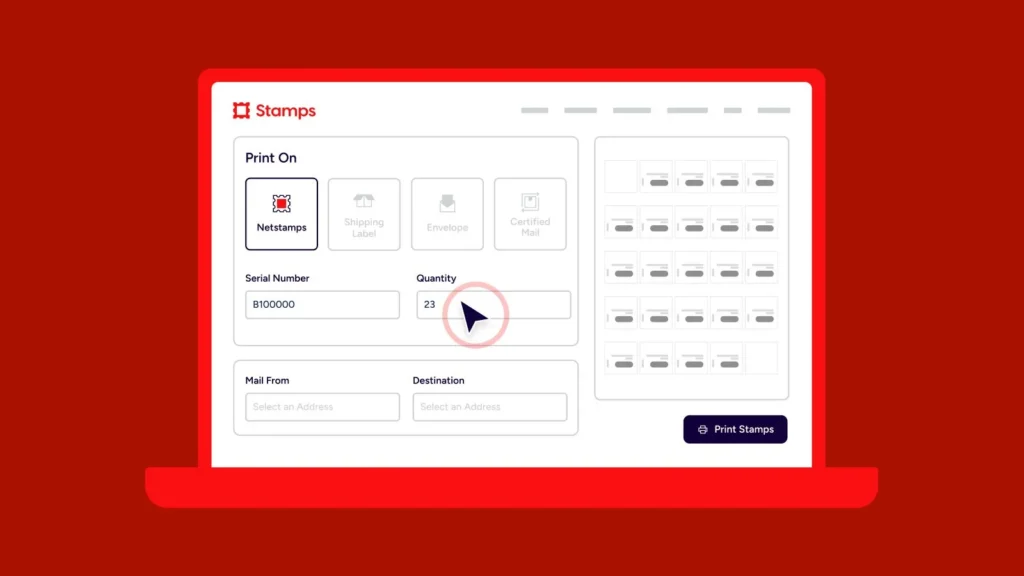
You can print NetStamps if you have a Stamps.com account with sufficient postage balance. After logging in to your account, simply select print on “NetStamps,” choose how many to print, select to print on a NetStamps sheet or roll, and click print!
Delivery is made by the country's postal service in 3 - 5 business days, depending on the destination.
Our rate advisor feature helps you calculate exact postage or shipping rate for anything you send. All you need is your item's weight and dimensions -- we do all the math for you and recommend cheapest, fastest, and best rates across all carriers.
USPS Ground Advantage delivery time is typically the slowest for domestic shipping services, taking two to five business days depending on the destination.
UPS Next Day Air offers guaranteed delivery by 10:30 a.m., 12:00 p.m., or end of day on the next business day, depending on the destination and specific service selected. Deliveries are made Monday through Friday, with Saturday delivery available in select areas for an additional fee.
Nonmachinable envelopes might be non-rectangular, rigid, unevenly thick, or have non-paper closures, meaning they cannot be processed efficiently by USPS's automated sorting equipment, and require special handling, resulting in a surcharge in addition to the standard postage.
USPS Priority Mail generally delivers in 2-3 business days. First-Class Mail, while more economical, typically takes 1-5 business days for delivery.
UPS Worldwide Saver is faster than UPS Worldwide Expedited, offering delivery by the end of the next business day to major business centers, compared to 2-5 business days for Worldwide Expedited. Worldwide Saver provides a more economical alternative to premium express services while maintaining quick delivery.
UPS Ground typically takes 1 to 5 business days for delivery with 90% of UPS® Ground packages being delivered in 3 days or less.
UPS Standard is generally faster than UPS Ground Saver, as it has a typical delivery window of 1-5 business days compared to Ground Saver's 2-7 business days.
UPS Next Day Air is significantly faster than UPS Second Day Air, delivering packages by the next business day, while UPS Second Day Air delivers within two business days. It's the fastest standard overnight service offered by UPS.
UPS Ground Saver is typically slower than UPS Standard, with delivery times ranging from 2-7 business days, whereas UPS Standard generally delivers within 1-5 business days.
UPS 3 Day Select is generally faster than UPS Ground Saver, offering guaranteed delivery within three business days, whereas Ground Saver can take 2-7 business days and has no guaranteed delivery time.
UPS 2nd Day Air is faster than UPS 3 Day Select, offering guaranteed delivery by the end of the second business day, while 3 Day Select provides guaranteed delivery by the end of the third business day.
Packages up to 15.999 ounces are priced in 4-ounce increments, while heavier packages are charged by the pound, rounded up. The further the distance, the higher the cost. Additional fees apply to oversized packages. Easily calculate discounted rates anytime at Stamps.com.
Educational materials like books, music, or videos that never include any products or advertising.
Stamps.com gives you access to all mailing and shipping services from USPS, UPS, DHL, and other top carriers. Visit stamps.com/carriers for a full list.
First-Class Mail International®
Flat Rate Envelopes are ideal for documents or small, dense items weighing 4 lbs or less, as they offer a single price based on the destination country. For items between 4 lbs and 70 lbs, or those that don't fit into the Flat Rate Envelopes, you'll need to ship by weight using your own packaging. It’s more affordable to use Flat Rate boxes if your item is under 20 lbs.