
















A real estate transaction can happen in days—sometimes hours. Offer windows close. Legal notices carry deadlines. The timeline from accepted offer to closed deal is packed with documents that have to reach the right person at the right time, with proof.
Stamps.com surveyed 500 professional services workers, including real estate professionals, to understand how mailing fits into their workweek. What the data shows: nearly three-quarters of real estate professionals say delivery tracking is very or extremely important to their business. And yet most are sending their most deal-critical documents the same way they’ve always sent them—a trip to a mailing location, a stamp, and hope.
The urgency that defines real estate hasn’t reached the mailroom.
Real estate mail gets treated like background admin. The documents moving through it say otherwise.
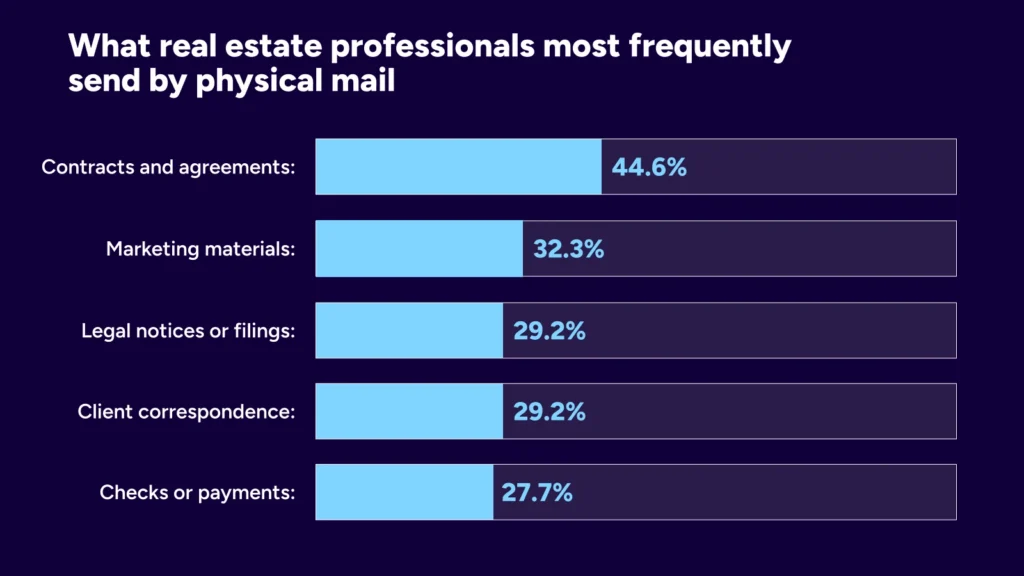
Contracts and agreements top the list—nearly half of real estate professionals send them by physical mail. Legal notices and filings aren’t far behind. Add checks, client correspondence, and marketing materials to that picture, and what’s leaving a real estate office isn’t routine correspondence. It’s the paper trail that transactions depend on.
That matters because the stakes aren’t uniform across document types. A delayed contract creates friction. A missed legal notice creates exposure. An untracked eviction notice in property management can mean starting a legal process from scratch.
Physical mail doesn’t feel high-stakes in the moment of sending. It tends to become high-stakes when something goes wrong.
If you’re not sure where mailing fits into your broader admin picture, this quiz is a good place to start.
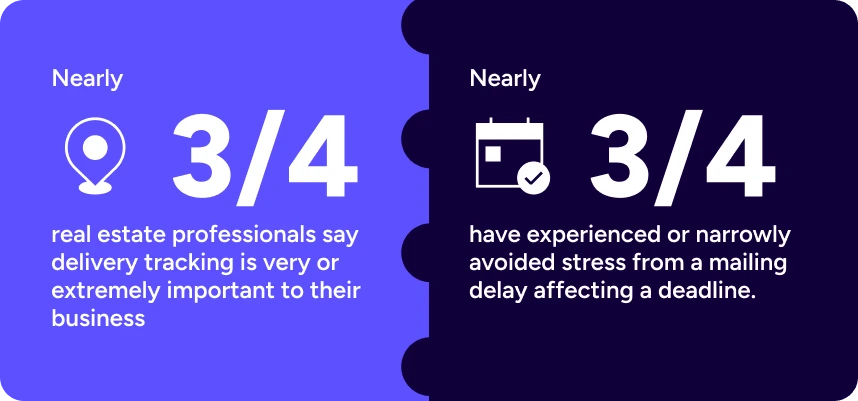
When a transaction depends on timing, documentation has to keep up. Nearly three-quarters of real estate professionals say delivery tracking is very or extremely important to their business—but the majority are using a process that doesn’t reliably give them that.
The consequences show up in the data. Nearly three-quarters have experienced or narrowly avoided stress from a mailing delay threatening a deadline. For 9.2%, it wasn’t a near-miss. It was a missed deadline, a penalty, or a client issue.
This is where tools like Certified Mail change the math. Sending a legal notice, a contract addendum, or a time-sensitive piece with tracking and proof of delivery isn’t about being overcautious—it’s about having documentation when a question comes up later. In real estate, those questions come up.
Real estate professionals track transaction costs closely. Commission structures, closing fees, carrying costs—these numbers get scrutinized because deals depend on them. Postage doesn’t get the same treatment.
Nearly 6 in 10 real estate professionals have overpaid for postage because they weren’t certain of the correct rate. Fewer than 1 in 5 track their postage spending precisely. Most are working from a rough estimate—or no estimate at all.
This isn’t a crisis. But good-enough workflows cost more than you think. It’s a quiet, recurring drain that compounds across every mailing, every month, and stays invisible because nobody’s measuring it.

If you’re ready to start closing that gap, here are five ways to streamline office mail in 2026.
Real estate moves at a pace that leaves little room for unnecessary friction. And yet the mailing process in most offices still looks like it did a decade ago: someone making a trip during business hours, calculating postage by feel, dropping off documents with no clean way to know what happened next.
Removing those trips adds up. More than half of real estate professionals said eliminating post office runs would save them at least 30 minutes to an hour per week. Nearly a quarter said they’d recover one to two hours. That’s the kind of time that gets absorbed into a busy schedule without anyone noticing it’s gone.
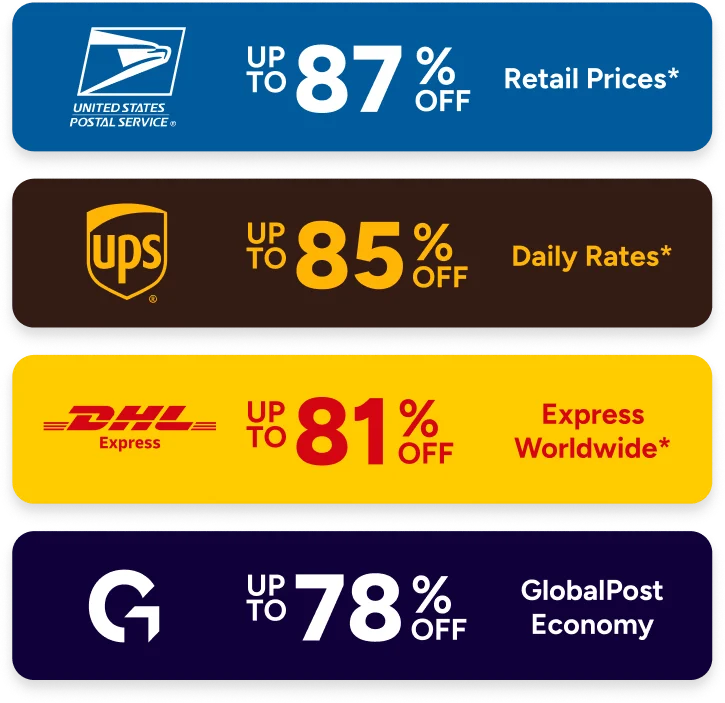
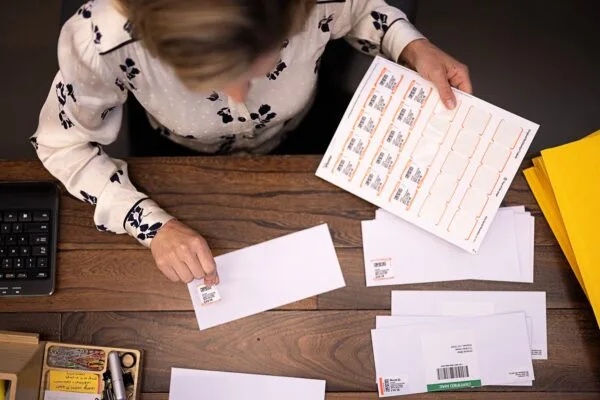
That’s where modernizing mailing for real estate professionals pays off. Print postage and labels from your desk. Schedule USPS pickups instead of making the run yourself. Send Certified Mail with automatic tracking and proof of delivery. Access discounted rates from USPS and UPS. Every piece that goes out gets logged—so when someone asks whether a document was sent and when, the answer is immediate.
“As soon as it became possible to print my own postage…are you kidding me? I was in.”
Jim Mahoney, Owner, Jim Mahoney Real Estate
The documents don’t stop. The trips do.

Mailing for real estate professionals isn’t going anywhere. Legal requirements, client preference, and the need for original signatures keep physical mail in place—and for the right documents, that’s exactly where it belongs. What can change is how much the process asks of the people running it.
The gap isn’t dramatic. It’s just persistent: the post office runs, the untracked packages, the postage guesswork, the “did that arrive?” follow-up with no quick answer. Closing it doesn’t require a major overhaul. It just means matching your mailing process to the pace of the business it supports.
Your deals move fast. Your mail can, too.Start mailing smarter with Stamps.com.
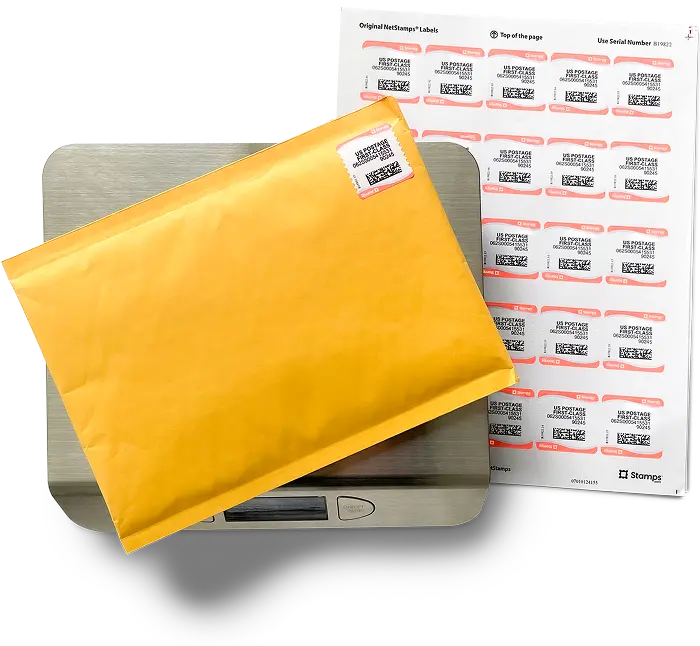
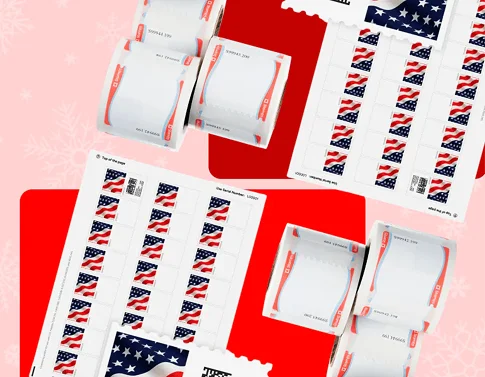
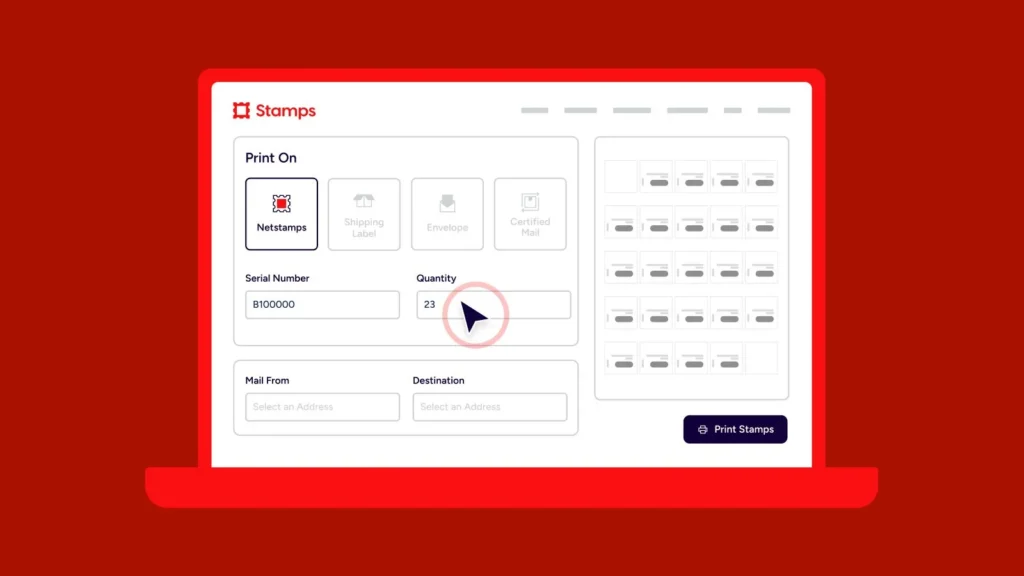
You can print NetStamps if you have a Stamps.com account with sufficient postage balance. After logging in to your account, simply select print on “NetStamps,” choose how many to print, select to print on a NetStamps sheet or roll, and click print!
Delivery is made by the country's postal service in 3 - 5 business days, depending on the destination.
Our rate advisor feature helps you calculate exact postage or shipping rate for anything you send. All you need is your item's weight and dimensions -- we do all the math for you and recommend cheapest, fastest, and best rates across all carriers.
USPS Ground Advantage delivery time is typically the slowest for domestic shipping services, taking two to five business days depending on the destination.
UPS Next Day Air offers guaranteed delivery by 10:30 a.m., 12:00 p.m., or end of day on the next business day, depending on the destination and specific service selected. Deliveries are made Monday through Friday, with Saturday delivery available in select areas for an additional fee.
Nonmachinable envelopes might be non-rectangular, rigid, unevenly thick, or have non-paper closures, meaning they cannot be processed efficiently by USPS's automated sorting equipment, and require special handling, resulting in a surcharge in addition to the standard postage.
USPS Priority Mail generally delivers in 2-3 business days. First-Class Mail, while more economical, typically takes 1-5 business days for delivery.
UPS Worldwide Saver is faster than UPS Worldwide Expedited, offering delivery by the end of the next business day to major business centers, compared to 2-5 business days for Worldwide Expedited. Worldwide Saver provides a more economical alternative to premium express services while maintaining quick delivery.
UPS Ground typically takes 1 to 5 business days for delivery with 90% of UPS® Ground packages being delivered in 3 days or less.
UPS Standard is generally faster than UPS Ground Saver, as it has a typical delivery window of 1-5 business days compared to Ground Saver's 2-7 business days.
UPS Next Day Air is significantly faster than UPS Second Day Air, delivering packages by the next business day, while UPS Second Day Air delivers within two business days. It's the fastest standard overnight service offered by UPS.
UPS Ground Saver is typically slower than UPS Standard, with delivery times ranging from 2-7 business days, whereas UPS Standard generally delivers within 1-5 business days.
UPS 3 Day Select is generally faster than UPS Ground Saver, offering guaranteed delivery within three business days, whereas Ground Saver can take 2-7 business days and has no guaranteed delivery time.
UPS 2nd Day Air is faster than UPS 3 Day Select, offering guaranteed delivery by the end of the second business day, while 3 Day Select provides guaranteed delivery by the end of the third business day.
Packages up to 15.999 ounces are priced in 4-ounce increments, while heavier packages are charged by the pound, rounded up. The further the distance, the higher the cost. Additional fees apply to oversized packages. Easily calculate discounted rates anytime at Stamps.com.
Educational materials like books, music, or videos that never include any products or advertising.
Stamps.com gives you access to all mailing and shipping services from USPS, UPS, DHL, and other top carriers. Visit stamps.com/carriers for a full list.
First-Class Mail International®
Flat Rate Envelopes are ideal for documents or small, dense items weighing 4 lbs or less, as they offer a single price based on the destination country. For items between 4 lbs and 70 lbs, or those that don't fit into the Flat Rate Envelopes, you'll need to ship by weight using your own packaging. It’s more affordable to use Flat Rate boxes if your item is under 20 lbs.