
















If you’re selling perfume, phone accessories with lithium batteries, or even hand sanitizer, there’s a good chance you’re already shipping hazardous materials—whether you realize it or not. HAZMAT compliance isn’t just a concern for businesses moving industrial chemicals. It touches a surprisingly wide range of everyday ecommerce products, and the consequences of getting it wrong range from delayed shipments to suspended accounts.
Shipping HAZMAT compliantly protects your business from costly penalties, account suspensions, and shipment delays. It also keeps postal workers, carriers, and customers safe by ensuring regulated materials are properly identified, packaged, and labeled throughout the shipping process. Here’s what qualifies as HAZMAT, how to ship it the right way, and what upcoming USPS changes mean for your business.
HAZMAT isn’t limited to industrial chemicals. Many common ecommerce products fall under USPS HAZMAT shipping regulations.
Here are a few examples of everyday items that may be regulated:
Hazardous materials are organized into nine official classes. These examples illustrate what falls into each class, but not all items can be mailed via USPS. Always check the USPS HAZMAT Shipping Safety Hub and Publication 52 for mailability before shipping. Pay special attention to Class 3 and Class 9 below, which are two of the most common ecommerce-related HAZMAT classes.
Class 1: Explosives
Materials capable of producing a sudden expansion of gas and heat. Examples: fireworks, sparklers, ammunition, safety fuses, model rocket engines, and emergency flares. According to USPS regulations, the vast majority of Class 1 items are strictly prohibited.
Class 2: Gases
Compressed, liquefied, or dissolved gases. Examples: aerosol sprays (hairspray, spray paint, deodorant), shaving cream, compressed air dusters, propane camping cylinders, and fire extinguishers.
Class 3: Flammable liquids
Liquids that give off flammable vapors at relatively low temperatures. Examples: perfumes, colognes, nail polish, rubbing alcohol, hand sanitizers, paint thinner, adhesives, and alcohol-based astringents. This is one of the most common ecommerce HAZMAT classes.
Class 4: Flammable solids
Solid materials that are easily ignited or can spontaneously combust. Examples: safety matches (strike-anywhere matches are generally prohibited), camphor, magnesium metal, and certain camping fire starters.
Class 5: Oxidizers and organic peroxides
Materials that yield oxygen readily to stimulate burning. Examples: hair bleaching powders, pool chemicals (chlorine tablets), concentrated hydrogen peroxide, and certain fertilizers.
Class 6: Toxic and infectious substances
Materials known to be toxic to humans, biological materials containing pathogens, or other items that are highly regulated or restricted. Examples: pesticides, rodent poisons, some agricultural chemicals, and biological lab samples.
Class 7: Radioactive materials
Materials that emit radiation. Examples: household smoke detectors (many contain trace amounts of Americium-241), certain medical isotopes, and antique watches or compasses with luminous radium dials.
Class 8: Corrosives
Liquids or solids that cause severe damage to human skin or corrode metals. Examples: liquid bleach, heavy-duty drain cleaners, wet-cell car batteries, rust removers, and industrial acids.
Class 9: Miscellaneous dangerous goods
Materials that present a transport hazard but don’t fit into other classes. Examples: lithium-ion batteries (standalone power banks or those inside laptops, phones, and toys), dry ice, strongly magnetized materials, self-inflating life rafts, certain first-aid kits, and other items frequently shipped by ecommerce companies. This is one of the most common ecommerce HAZMAT classes.
The common thread? These products contain ingredients or components that can be flammable, corrosive, pressurized, or otherwise hazardous during transport. And even if the consumer-facing product seems harmless on a store shelf, it can pose real risks if it’s not properly packaged and declared.
Regardless of which carrier you’re using, HAZMAT compliance follows a consistent logic: identify the material, confirm it can be shipped, package it correctly, and verify both the physical box and the digital label reflect what’s inside. Here’s how that breaks down with USPS.
Step 1: Identify your product via the Safety Data Sheet (SDS)
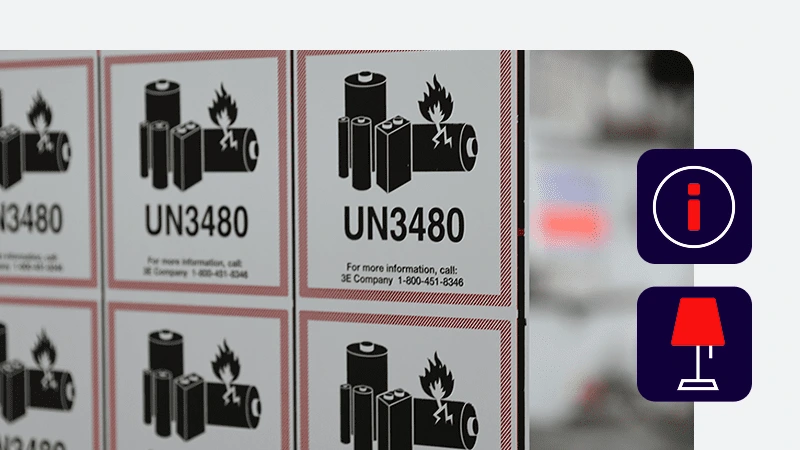
Every chemical or hazardous product has a standardized SDS, typically available on the manufacturer’s website. Search for the manufacturer name + product name + SDS. Locate Section 14 (Transport Information) of the SDS, find the UN Number (United Nations) or NA Number (North American), and the proper shipping name (e.g., UN1266 for perfumery products).
Step 2: Verify mailability with the USPS HAZMAT Tool and Publication 52
Enter the UN/NA number into the USPS HAZMAT Tool or check Publication 52, Appendix A. The tool confirms whether the item can be mailed, whether it’s restricted to surface transport only (e.g., USPS Ground Advantage™) versus air transport (Priority Mail®), and what packaging instructions apply. Shipping a ground-only item via air isn’t a paperwork issue—it’s a serious safety violation
Step 3: Make sure your item can be shipped
According to its guidelines, USPS does not carry all of the types of HAZMAT shipped in the U.S. Strictly prohibited items include those with visible liquid mercury, certain explosives (Division 1.4, 1.5, 1.6), poisonous or toxic gases (Division 2.3), spontaneously combustible solids, and materials that are dangerous when wet (Division 4.3). If your product falls into a prohibited category, you’ll need to explore alternative carriers.
Step 4: Follow three-layer packaging and quantity limits
USPS generally only accepts limited quantities (consumer-sized amounts). The three-layer method includes:
Step 5: Apply physical markings to the box
Packages must display the correct Department of Transportation (DOT) warning labels, usually the black-and-white “Limited Quantity” diamond mark for ecommerce and small business shippers. Ground-restricted items must be marked “Surface Transportation Only” or “Surface Mail Only.” If reusing a box with old HAZMAT markings, those markings must be completely covered or removed if the new shipment doesn’t contain those materials.
Step 6: Handle digital compliance
The shipping label must include the correct Service Type Codes (STC) and Extra Service Codes (ESC) so USPS systems recognize the package as HAZMAT.
For a more detailed walk-through, view USPS’s HAZMAT shipping tutorial.
The stakes for non-compliance aren’t hypothetical. Failing to declare or incorrectly labeling HAZMAT can lead to a carrier suspending your account or API access—halting your ability to ship anything, not just hazardous materials. Non-compliant packages may be delayed, returned to sender, or destroyed without a refund. And every one of those outcomes translates to a customer who didn’t get their order, a negative review, or lost repeat business.
HAZMAT handling fee:
A new per-piece surcharge applied at the time of mailing for packages containing hazardous materials. It applies to Priority Mail Express, Priority Mail, and Ground Advantage.
USPS has not officially announced the exact dollar amount for these handling fees yet.
HAZMAT noncompliance fee:
A monthly penalty assessed on commercial packages that fail to comply with USPS HAZMAT shipping regulations—whether due to missing or incorrect STC/ESC codes, missing physical label markings, or attempting to ship unapproved items. There is no threshold or grace period. The fee is charged on every non-compliant package.
USPS has not officially announced the exact dollar amount for these noncompliance fees yet.
This blog post will be updated with more information as it becomes available from USPS.
We offer new customers free supplies including free NetStamps and a 5 lb scale so they can get started with the basics required to get the most out of Stamps.com
Yes. You can connect your shopping carts and marketplaces including Shopify, eBay, Amazon, and Etsy with Stamps.com in under 5 minutes. You can also import your orders from a CSV file, Microsoft Excel, XML, or your own ODBC.
Yes. Stamps.com allows you to print up to 10,000 labels in one click.
Yes. You can add users to the same Stamps.com account - user limits vary by plan. If your organization has multiple locations, you can switch to our multi-location plan. Visit stamps.com/multilocation to learn more
Yes, when you are configuring your label, all you have to do is enter your recipient's email address to ensure they receive tracking information for their package. This email includes the delivery address, mail date, mail class, estimated delivery date, special services, a customizable personal note, and a link with the tracking number.
Yes. Stamps.com can pull order or customer information from virtually any database, from Excel to SQL. Stamps.com also creates an export file that includes mail class, mail date, shipping cost, and tracking number.
Log in and navigate to your subscription page to cancel from within the app, or simply call our toll-free number 855-608-2677, M–F 8AM to 8PM CT and our customer support team will be happy to assist you. You can cancel any time.
We offer new customers a 30-day risk free trial to see if Stamps.com is right for them. Cancelling any time within the 30-day time frame will result in no charges; however, if you continue past your 30‑day trial, you will be charged a monthly subscription including your first month's fee. Your service will continue uninterrupted unless you cancel.
Yes. After you're printed your shipping label, you can generate a pre-addressed pre-paid return label your clients can use to send items back.
No. DHL Express typically does not deliver on Sundays in most regions. However, Sunday delivery may be available in select areas or for time-definite international shipments with specific service upgrades. Check with DHL directly for regional availability.
Drop off your shipment 24 hours a day, seven days a week at one of the 60,000 UPS dropoff locations across the United States. This includes UPS Stores, UPS Drop Boxes, CVS, Michaels, and Advanced Auto Parts.
You can log into your app and visit your "history" page to view real-time tracking information for every item you send. You can also enter your tracking number on the UPS website to see tracking updates.
USPS Ground Advantage delivery time is typically the slowest for domestic shipping services, taking two to five business days depending on the destination.
UPS Ground Saver is typically slower than UPS Standard, with delivery times ranging from 2-7 business days, whereas UPS Standard generally delivers within 1-5 business days.
UPS Ground tracking uses a system of scans to update customers on the location and status of their packages as they move through the UPS network. Each package is assigned a unique tracking number, and as it travels, it's scanned at various points, including when it's received, when it's transferred between facilities, and when it's out for delivery.
UPS Worldwide Saver is faster than UPS Worldwide Expedited, offering delivery by the end of the next business day to major business centers, compared to 2-5 business days for Worldwide Expedited. Worldwide Saver provides a more economical alternative to premium express services while maintaining quick delivery.
USPS Priority Mail generally delivers in 2-3 business days. First-Class Mail, while more economical, typically takes 1-5 business days for delivery.
UPS Next Day Air offers guaranteed delivery by 10:30 a.m., 12:00 p.m., or end of day on the next business day, depending on the destination and specific service selected. Deliveries are made Monday through Friday, with Saturday delivery available in select areas for an additional fee.
UPS Standard generally delivers within 1 to 5 business days, with residential deliveries typically occurring between 9 AM and 9 PM. The exact delivery time depends on the distance the package travels and the specific destination.
UPS 2nd Day Air guarantees delivery by the end of the second business day. For time-critical shipments, you can choose UPS 2nd Day Air A.M., which delivers by 10:30 AM, 12:00 PM, or 2:00 PM (depending on destination) on the second business day.
UPS Ground typically takes 1 to 5 business days for delivery with 90% of UPS® Ground packages being delivered in 3 days or less.
UPS Standard is generally faster than UPS Ground Saver, as it has a typical delivery window of 1-5 business days compared to Ground Saver's 2-7 business days.
UPS Next Day Air is significantly faster than UPS Second Day Air, delivering packages by the next business day, while UPS Second Day Air delivers within two business days. It's the fastest standard overnight service offered by UPS.
UPS 3 Day Select is generally faster than UPS Ground Saver, offering guaranteed delivery within three business days, whereas Ground Saver can take 2-7 business days and has no guaranteed delivery time.
UPS 2nd Day Air is faster than UPS 3 Day Select, offering guaranteed delivery by the end of the second business day, while 3 Day Select provides guaranteed delivery by the end of the third business day.
Our multi-location plan, designed for companies with 2+ office locations, gives each location the ability to print postage and labels as needed, while capturing information about how much is sent and spent in a single dashboard to give the business the ability to budget. No leases, no contracts, and best-in-class support available when your users need it. Visit stamps.com/multi-location to learn more
After a label is printed, Stamps.com automatically uploads the USPS tracking numbers, order info, and mail class back to the order source, including eBay, Amazon, Etsy, and your shopping cart.
UPS 3 Day Select guarantees delivery by the end of the third business day after the package is picked up, with deliveries typically occurring Monday through Friday. It's a reliable option for shipments that aren't time-critical but need to arrive within a specific timeframe.
UPS Ground Saver typically delivers packages within 2 to 7 business days across the contiguous United States.
UPS Worldwide Saver guarantees delivery by the end of the business day, one day faster than UPS Worldwide Expedited. This service connects major business centers in over 220 countries and territories with time-definite delivery and customs clearance included.
Packages up to 15.999 ounces are priced in 4-ounce increments, while heavier packages are charged by the pound, rounded up. The further the distance, the higher the cost. Additional fees apply to oversized packages. Easily calculate discounted rates anytime at Stamps.com.
USPS Priority Mail typically takes one to three business days, depending on destination, to deliver. You can easily check for a delivery time estimate on USPS’s Priority Mail Delivery Map.
DHL Express is a premium international shipping service that offers fast, time-definite delivery to over 220 countries and territories. It's designed for urgent packages, with door-to-door tracking, customs support, and express delivery options for businesses and individuals.